A tungsten electrode that is too large, incorrectly matched to the current, or ground with the wrong geometry can produce wandering arcs, poor penetration and tungsten inclusions. You will be able to match electrode composition, diameter, tip shape and preparation to your material, polarity, amperage and AC waveform before you start welding.
Key takeaways
- Choose tungsten composition by polarity before selecting diameter.
- Use electrode diameter charts with amperage, material and AC or DC polarity.
- Grind the tip lengthwise and keep it free from steel, oil and moisture.
- Specify grade, diameter, tip geometry and packaging when ordering electrodes.
Match the tungsten composition to polarity and base metal
Choose the tungsten composition by polarity first, then by current and base metal. For AC aluminium and magnesium, pure tungsten EWP forms a stable balled end, while 1% zirconiated EWZr-1 resists tungsten contamination and holds its shape better. Modern AC inverters can also use lanthanated or rare-earth electrodes with a controlled point.
| Electrode | Best match | Practical distinction |
|---|---|---|
| EWP | AC aluminium, magnesium | Stable ball; weaker choice for low-current DC |
| EWZr-1 | AC aluminium, magnesium | Better contamination resistance; not a fine low-current DC choice |
| EWLa-1.5 | AC or DCEN | Easy starts and versatile performance |
| EWLa-2 | DCEN steel, stainless steel, copper, titanium, nickel alloys | Strong general-purpose option with good starts and current capacity |
| EWCe-2 | Low-current DC and precision work | 2% ceriated tungsten EWCe-2تk3 suits easy starting; verify that marking |
| Rare-earth blends | Varied-current or mixed AC/DC work | Properties depend on the manufacturer’s oxide blend |
Use pure tungsten or zirconiated tungsten when AC aluminium or magnesium demands a stable, contamination-resistant ball. Use 2% lanthanated tungsten for DCEN welding of mild steel, stainless steel, copper, titanium and nickel alloys.
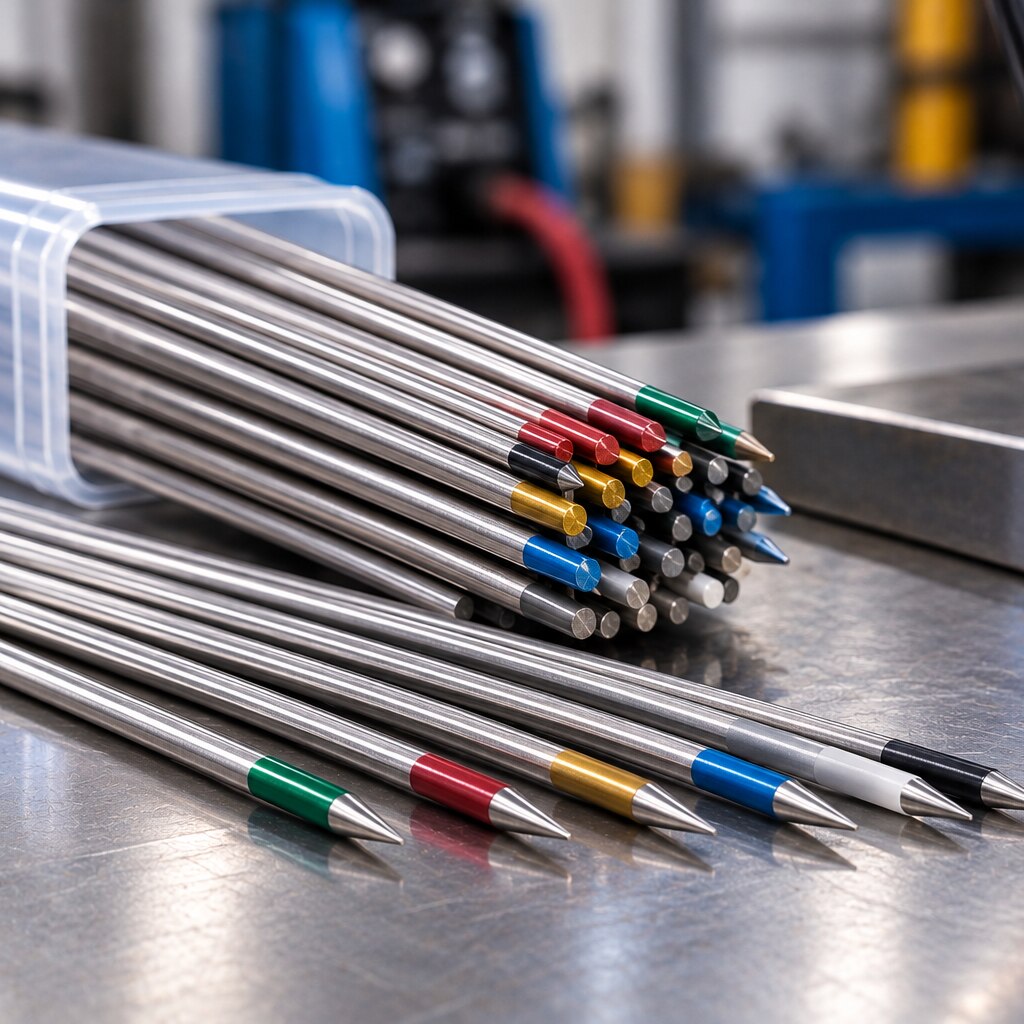
Do not substitute thoriated EWTh-2 because another electrode is red-coded. Thorium is radioactive, and grinding dust requires appropriate occupational controls. Confirm AWS A5.12/A5.12M composition designations; colour alone is less reliable.
Choose diameter from amperage, polarity and material thickness
A 1.6 mm tungsten electrode is not automatically correct for thin sheet. Select diameter from welding current, DCEN or AC polarity, base-metal thickness, joint access and the machine’s stable operating range. Thickness determines heat demand; it does not determine electrode diameter by itself.
Use these figures as starting points for a DCEN TIG current range, not as universal limits:
| Diameter | Practical DCEN TIG current range | Starting consideration |
|---|---|---|
| 1.0 mm | 10–80 A | Fine, low-current joints and thin sheet |
| 1.6 mm | 20–150 A | General thin and medium sections |
| 2.4 mm | 40–250 A | Higher-current fabrication |
| 3.2 mm | 80–350 A | Heavy sections and sustained current |
An undersized electrode overheats, erodes and contaminates the weld with tungsten. An oversized electrode is difficult to start and control at low amperage, particularly on a basic inverter.
AC TIG current range changes with waveform, AC balance, electrode alloy and cooling. A modern inverter with high-frequency starting and adjustable waveform can run a smaller, controlled electrode on aluminium; an older transformer often needs a larger electrode and conventional ball.
TIG welding aluminium thickness still matters because thicker sections demand more current and heat, but the machine’s duty cycle and cooling limit the usable range.
For aluminium and magnesium, confirm the manufacturer’s AC data rather than copying DC values. Check the final amperage range against the electrode manufacturer’s specification before ordering or welding.
Set the point, taper and stick-out for arc control
Grind the tungsten electrode tip geometry to match current and access, not to make every electrode needle-sharp. A long, sharp taper concentrates a low-current DC arc for narrow penetration and precise pool control, but the fragile point overheats or breaks easily. Use a shorter taper or truncated tungsten tip at higher current.
| Tip form | Arc width | Penetration and pool control | Starting behaviour |
|---|---|---|---|
| Blunt | Broad | Shallow, forgiving control | Robust, less precise |
| Pointed | Narrow | Deep, precise | Excellent at low current; fragile |
| Balled | Broad and diffuse | Wide pool, limited direction | Conventional AC aluminium start |
| Truncated | Controlled, slightly broad | Stable penetration and repeatable pool | Reliable at higher current |
Choose an included grinding angle around 20–30 degrees for low-current DC precision, then use a shorter taper for heavier work. A small flat at the point is a repeatability choice, not a universal rule; match it to the electrode maker’s data and your amperage.
Set TIG tungsten stick-out at roughly 1 to 1.5 cup diameters as a starting point. Extend it only enough to see a recessed corner or deep joint: excessive extension weakens shielding, overheats the electrode and invites oxidation. A gas lens can support more extension, but drafts and poor cup coverage still win.
On modern AC inverters, use a controlled pointed or truncated lanthanated electrode with suitable balance and waveform settings; reserve a conventional ball mainly for transformer-style AC aluminium work.
Grind and protect the electrode without introducing contamination
Grind along the electrode, not around it. Longitudinal tungsten grinding on a dedicated tungsten grinder or clean diamond wheel guides the arc toward the point; grinding across the electrode encourages arc wandering. Never use a bench-grinder wheel contaminated with steel, because embedded iron creates tungsten contamination and weld-metal inclusions.
If the tungsten touches the molten pool or filler wire, remove it from service, let it cool safely, and regrind beyond the contaminated section. Do not brush the deposit clean; residual contamination can produce unstable starts, inclusions and inconsistent penetration.
Protect the tip with complete TIG gas shielding and post-flow. Choose a cup that covers the arc, eliminate drafts, and leak-test the torch, hose and fittings. Set post-flow long enough to shield the electrode until it is no longer visibly hot; higher current and larger diameters need longer protection.
Excessive stick-out weakens coverage, oxidises the tip and can falsely suggest the electrode grade is wrong.
Use these repeatable controls for production work:
- Regrind when the point blunts, chips, discolours or wanders; remove all damaged length rather than polishing the mark.
- Clean the collet and collet body before installation; replace parts that cannot grip concentrically.
- Check electrode concentricity and hold electrode length to a fixed gauge dimension.
- Use a controlled grinding fixture and recorded tip geometry for automated or high-repeatability welding.
- Reject a tip after any molten-pool contact until it has been safely cooled and reground.
Turn the choice into a purchase and welding specification
Write the tungsten electrode procurement specification so the delivered parts match the weld procedure, not merely the catalogue picture.
1. State the AWS A5.12/A5.12M tungsten classification and oxide composition: for example, EWLa-1.5, EWLa-2, EWCe-2 or EWZr-1. Name the rare-earth tungsten blend and its oxide percentages if it is not a standard designation.
2. Specify diameter and cut length, such as 1.6 mm × 150 mm, plus diameter and length tolerances. Tight tolerances matter in automated welding because changing stick-out shifts the arc position.
3. Define the surface finish: straight, clean, burr-free electrodes with a longitudinally ground surface and no oil, chips or transverse grinding marks.
4. State the colour or marking system, but verify the manufacturer’s marking against the certificate. Tungsten electrode colour codes vary; a colour-only order can substitute the wrong alloy.
5. Require sealed packaging that protects the tips from moisture, dust and impact, with the classification printed on each inner pack.
6. Require heat or batch numbers, manufacturing date and a certificate linking the delivered lot to its chemical composition.
7. Specify regrind requirements: permitted tip geometry, maximum contaminated length to remove, longitudinal grinding direction and rejection criteria for bent or cracked electrodes.
Keep separate electrodes for AC aluminium, low-current precision work and DCEN production welding. This prevents a balled AC electrode or a coarse high-current preparation from entering a fine stainless or titanium job. RND Welding Pvt Ltd can quote against the exact classification and batch details, rather than a colour, nominal size or application label alone.
Related product
 | Welding Electrodes ₹ 600/PieceGet Latest Price Size 2.5mmX450mm Diameter 2.5 mm X 450 mm Brand Ador Material Copper Application/Usage Construction Country of origin... View product → |
Frequently asked questions
Which tungsten composition suits AC aluminium and magnesium TIG welding?
Pure tungsten EWP forms a stable balled end on conventional AC. EWZr-1 resists tungsten contamination and holds its shape better, while modern AC inverters can use lanthanated or other rare-earth electrodes with a controlled point.
How do you choose tungsten electrode diameter?
Match diameter to welding amperage, polarity and material thickness. Use the manufacturer’s amperage range for the electrode and account for the higher heat load of AC compared with DCEN.
How should you grind a tungsten electrode for TIG welding?
Grind the electrode lengthwise with a dedicated tungsten wheel or diamond wheel. Use a consistent taper and truncated tip, and remove contamination before restarting the weld.
What should a tungsten electrode purchase specification include?
State the AWS classification, alloy composition, diameter, electrode length, tip condition, packaging and required batch traceability. Add the welding current, polarity and base metal so the supplier can check compatibility.