Choosing an arc electrode involves more than matching a diameter or buying an AC/DC-compatible product. You need to read the AWS classification, then match coating, polarity, current, position and deposited-metal chemistry to the joint and its service conditions.
Key takeaways
- Read E7018 as strength, position, coating, current compatibility and arc characteristics.
- Choose electrode chemistry for the joint metal and the service environment.
- Set electrode diameter, amperage and welding position as one decision.
- Keep low-hydrogen electrodes dry and verify batch details before welding.
How to Read an AWS Arc-Electrode Classification
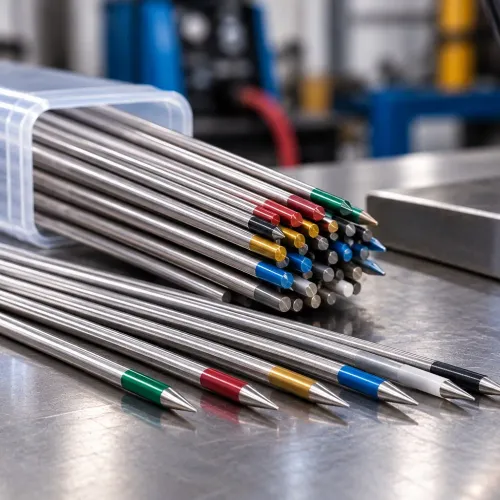
Read an AWS electrode classification from left to right: E means electrode; the first two or three figures state minimum weld-metal tensile strength in ksi; the next digit identifies welding-position capability; and the final digit identifies coating, current compatibility and arc characteristics.
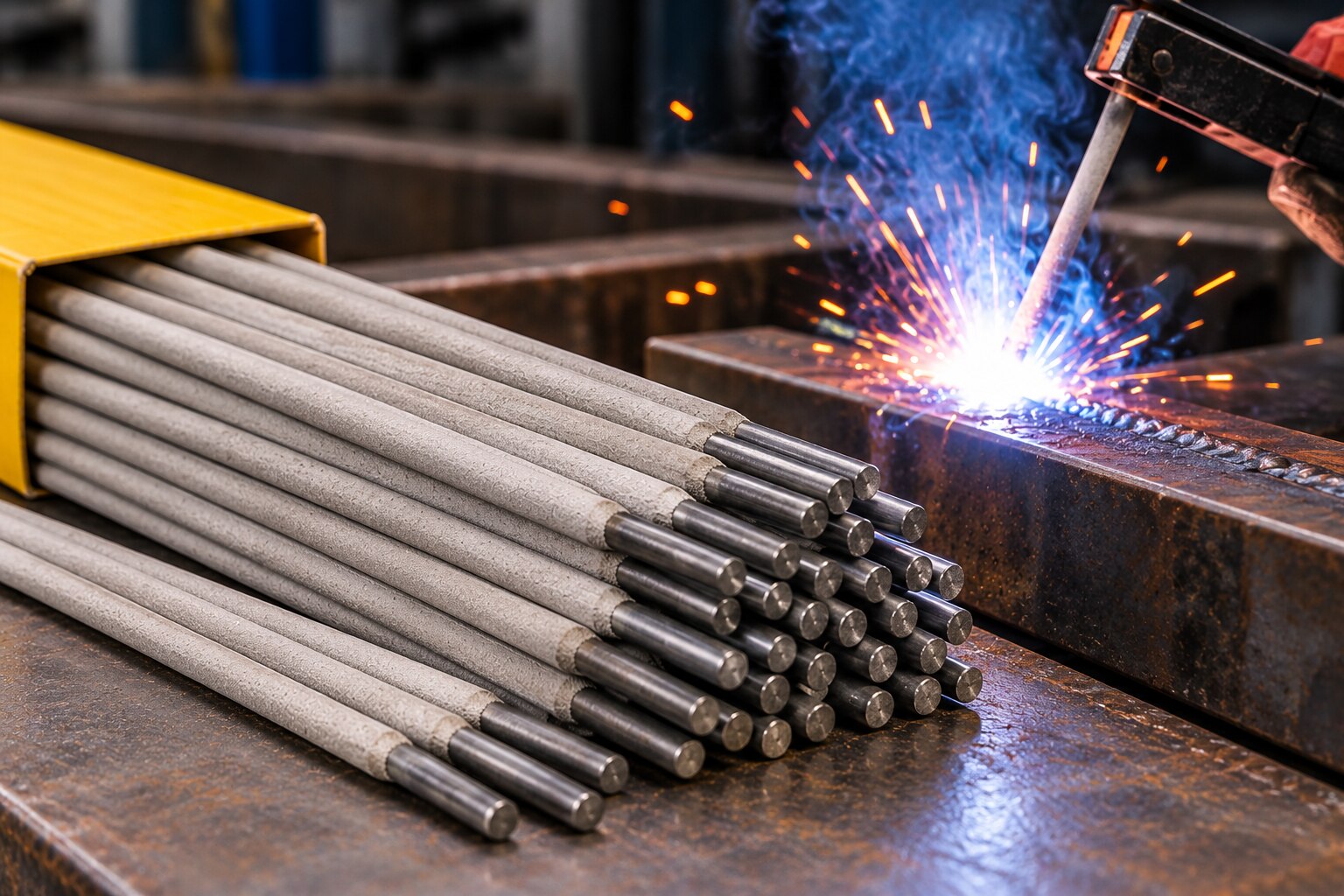
1. Decode E6013 as 60 ksi minimum tensile strength, all-position capability, and a rutile general-fabrication coating. Decode E7018 as 70 ksi, all-position, low-hydrogen iron-powder. Its value in restrained joints is hydrogen control, not tensile strength alone.
2. Treat E6010 and E6011 as related but non-interchangeable. E6010 is normally used with DCEP for deep penetration and root passes; E6011 uses a potassium-based coating that supports AC and DCEP, producing different arc and root-profile behaviour.
3. Read E11018M as a higher-strength, low-hydrogen classification: 110 ksi is minimum tensile strength, not guaranteed yield strength or procedure approval. The E11018M/Conarc 80 material context still demands matching base-metal strength, toughness, preheat, interpass temperature and joint design.
4. Do not apply carbon-steel numbering to nickel electrodes. E Ni-1 and E NiCrMo-1 are selected by deposited nickel-alloy chemistry, service medium and dilution, not by a 60- or 70-ksi sequence.
5. Confirm the classification against a qualified WPS and PQR before production. AWS D1.1 or ASME Section IX can impose limits on position, thickness, heat input and essential variables that the electrode label cannot establish.
What Electrode Coverings and Polarity Change in the Arc
Covering chemistry controls arc starting, penetration, slag, hydrogen, bead shape and welding position more than the strength number suggests.
| Type | Arc and weld effects | Practical limit |
|---|---|---|
| Rutile electrode | E6013 starts easily, runs smoothly, produces moderate penetration, a neat bead and readily detached slag. | A poor choice when deep root penetration or low-hydrogen control governs. |
| Cellulose electrode coating | E6010 and E6011 use an organic coating that decomposes into shielding gas, creating a forceful arc, deep penetration and a fast-freezing slag suited to open-root passes. E6010 normally uses DCEP; E6011 also supports AC. | The aggressive arc and rougher profile demand tighter technique. |
| Basic electrode | E7018 is a low-hydrogen electrode with iron powder and a protective slag system. It gives a controlled arc, smooth profile and lower hydrogen potential when kept dry and handled correctly. | Moisture defeats the low-hydrogen advantage. |
| Iron-powder E7024 | High deposition rate and a fluid weld pool suit flat welds and horizontal fillet welds. | Do not substitute it for an all-position E7018. |
Polarity changes arc stability, heat distribution and penetration. DCEP concentrates more heat at the electrode and often supports penetrating arcs; DCEN shifts more heat toward the workpiece, while AC repeatedly reverses current and depends heavily on machine waveform and voltage. “AC/DC” does not make settings equivalent.
- Check the datasheet for permitted polarity.
- Match the power source’s open-circuit voltage and waveform to the stated operating range.
- Run a test bead before changing polarity; a wrong setting can cause arc extinguishing, excessive penetration or poor fusion.
Match Electrode Chemistry to the Joint and Industrial Service
Choose the electrode from the base metal first, then test the joint against position, thickness, restraint, service temperature, strength, corrosion and wear demands. A mismatch can produce shallow fusion, cracking or premature service failure even when the weld looks sound.
| Electrode | Best fit | Main limitation |
|---|---|---|
| E6013 | General fabrication, light-to-medium sections and easy operation | Moderate penetration and 60 ksi-class strength; not the choice for deep-root joints, highly restrained welds or low-hydrogen-critical work |
| E7018 | Thick, restrained or higher-strength carbon and low-alloy steel joints | Requires controlled low-hydrogen storage, suitable preheat and a qualified procedure |
| E308L-16 | 304/304L-type austenitic stainless steel | Low carbon does not guarantee corrosion immunity; grade, dilution and service medium still control suitability |
| E316L-16 | 316/316L-type service needing molybdenum-associated resistance | It remains unsuitable when contamination, heat tint or the service chemistry exceeds the alloy’s resistance |
| E Ni-1 | Suitable nickel alloys and selected cast-iron repairs | Confirm base-metal compatibility and repair procedure before welding |
| E NiCrMo-1 | Nickel-chromium-molybdenum deposits for demanding corrosion-resistant applications | Match deposited chemistry to the actual medium and temperature |
The L in E308L-16 and E316L-16 means low carbon. It reduces sensitisation risk during thermal exposure; it does not provide universal corrosion protection.
For industrial welding applications, use E7018 where restraint, thickness or higher strength raises hydrogen-assisted cracking risk. Follow a qualified WPS/PQR under AWS D1.1 or ASME Section IX; the classification alone is not procedure approval.
For hardfacing, specify the wear mechanism: abrasion, impact, cavitation, metal-to-metal wear or corrosion. Balance hardness against toughness, because the hardest deposit can crack or spall under impact.
Set Electrode Diameter, Amperage and Welding Position Together
Start by pairing electrode diameter with current and position, not by choosing the largest rod. Use these approximate SMAW starting points:
- 2.5 mm electrode current: around 60–90 A; useful for root passes, thin plate and narrow gaps.
- 3.15 mm electrode current: around 90–130 A; a practical middle range for many general-fabrication joints.
- 4.0 mm electrode current: around 130–180 A; suited to thicker sections when joint access and position allow it.
Treat any SMAW amperage chart as a starting reference. Coating type, power source, joint design, fit-up and the electrode manufacturer’s datasheet alter the usable range, so set the final current from that datasheet.
Flat welding can use the upper part of a range because the weld pool remains supported. Vertical and overhead work usually need lower current, shorter arc length and tighter travel control; excessive amperage causes sagging, undercut and poor bead shape.
Higher current and diameter can raise deposition rate, but productivity also depends on arc time, stub loss, slag removal and position limits. A large electrode that cannot control a root pass or overhead bead is not the faster choice.
Check the following before welding:
- Confirm machine polarity and current range against the datasheet.
- Reduce diameter for thin material, narrow gaps and root work.
- Treat iron-powder efficiency above 100 percent as a core-wire comparison: coating metal contributes to deposited weld metal, but the calculation excludes the total purchased electrode mass.
Control Moisture, Verification and Consumable Supply Before Welding
A damp E7018 can raise weld-metal diffusible hydrogen and trigger delayed cracking in thick, restrained or higher-strength joints. Keep E7018 and similar low-hydrogen electrodes in unopened, intact packaging until issue; after opening, record exposure time and transfer them to a holding oven within the manufacturer’s stated limit.
Follow rebaking instructions from manufacturer: use the exact temperature and time on that electrode’s datasheet, not a universal oven setting. The packaging, governing code and exposure limit control.
Moisture control is hydrogen cracking prevention, not housekeeping. A nominal E7018 classification does not prove correct storage; damp electrodes can cause failed inspection and costly gouging, rewelding and delay. Control preheat, interpass temperature and procedure qualification under AWS D1.1 or ASME Section IX where the project requires them.
| Storage state | Required action | Risk if ignored |
|---|---|---|
| Unopened, intact pack | Keep sealed until issue | Moisture pickup before use |
| Opened pack | Record exposure time | Unknown usable life |
| Within stated limit | Move to holding oven | Uncontrolled exposure |
| Suspect or overexposed | Apply datasheet rebaking instructions or quarantine | Hydrogen-related repair |
- Classification and diameter match the WPS.
- Batch or lot number is traceable.
- Polarity and current range suit the welding machine.
- Storage and exposure instructions are available.
- Mill certificates or certificates of conformance are present.
- WPS/PQR compatibility and project-code acceptance are confirmed.
A Mumbai fabricator or repair team can use RND Welding Pvt Ltd to compare documented consumable options, while the manufacturer’s datasheet and project code remain the basis for acceptance.
Related products
 | Welding Electrodes Material Mild Steel Length 350 mm Size 3.15 mm Brand Lincoln Model Name/Number Conarc 80 Diameter 3.2mm Established in the year of 2018, RND Welding... View product → |
 | Welding Electrodes Size 2.5mmX350mm Material Copper Certification AWS CE ISO Operating Current AC/DC Application/Usage Automotive Welding current range 120 A... View product → |
Frequently asked questions
How do you read an AWS arc-electrode classification?
Read it from left to right: E identifies the electrode, the first two or three figures give minimum tensile strength in ksi, the next digit shows welding position, and the final digit identifies coating, current compatibility and arc characteristics.
How do electrode coverings and polarity affect welding?
The covering controls shielding gas, slag formation, arc stability and hydrogen exposure. The final classification digit indicates compatible current and polarity, so match it to the power source and welding procedure.
How should you match electrode chemistry to an industrial joint?
Match deposited weld-metal chemistry and strength to the base metal, joint restraint and service conditions such as impact, heat, corrosion or wear. Use the welding procedure specification when one exists.
How do you choose electrode diameter and amperage?
Choose diameter from material thickness, joint access and welding position, then set amperage within the manufacturer’s range. Reduce heat input and diameter for vertical or overhead work when the procedure requires it.
Related products
 | Welding Electrodes Diameter 2.5 mm X 450 mm Material Stainless Steel Size 2.5,3.15,4.0mm Electrode Length 350/450 mm Application/Usage Construction Brand ESAB Welding... View product → |
 | Welding Electrodes E nicrcomo-1welding electrodes ₹ 4,000/KgGet Latest Price Diameter 2.5 mm X 450 mm Material Stainless Steel Brand Arcos Application/Usage Construction Operating Current AC/DC Size... View product → |
 | Stainless Steel Welding Electrodes ₹ 3,800/KgGet Latest Price Length 350 mm Material Stainless Steel Operating Current AC/DC Brand Arocos Size 3.15 mm Application/Usage Construction We... View product → |
 | Welding Electrodes Diameter - 2.5/3.15/4.00mm Material Mild Steel Operating Current AC/DC Application/Usage Construction Packaging Type Box Length - 350/450mm We are... View product → |