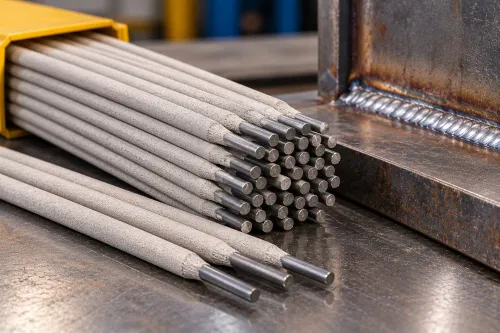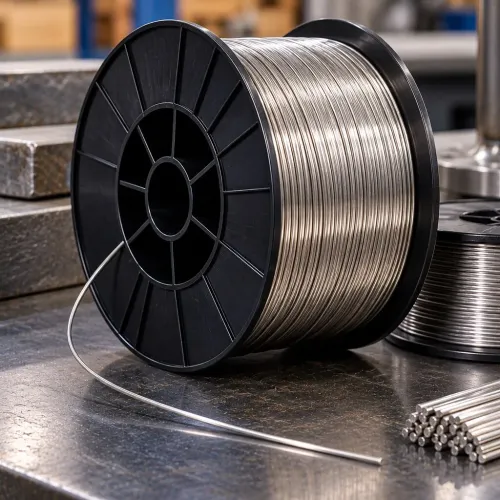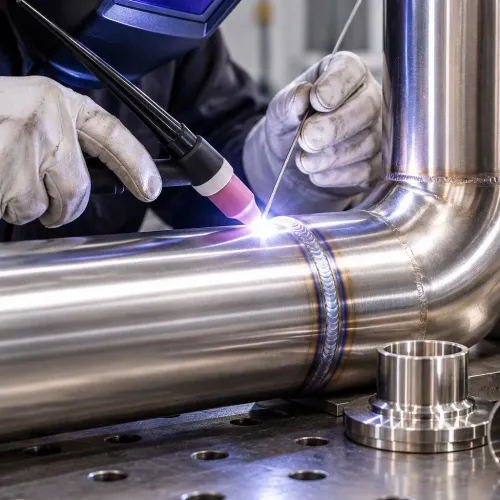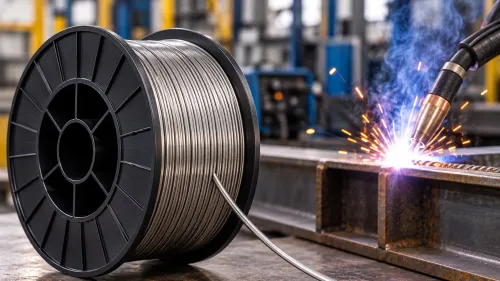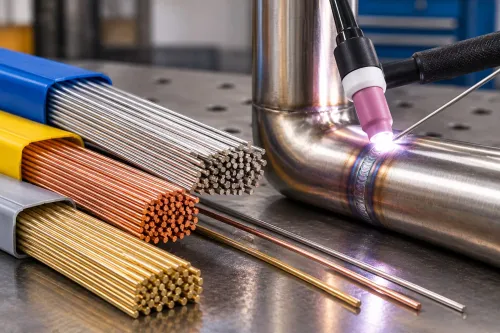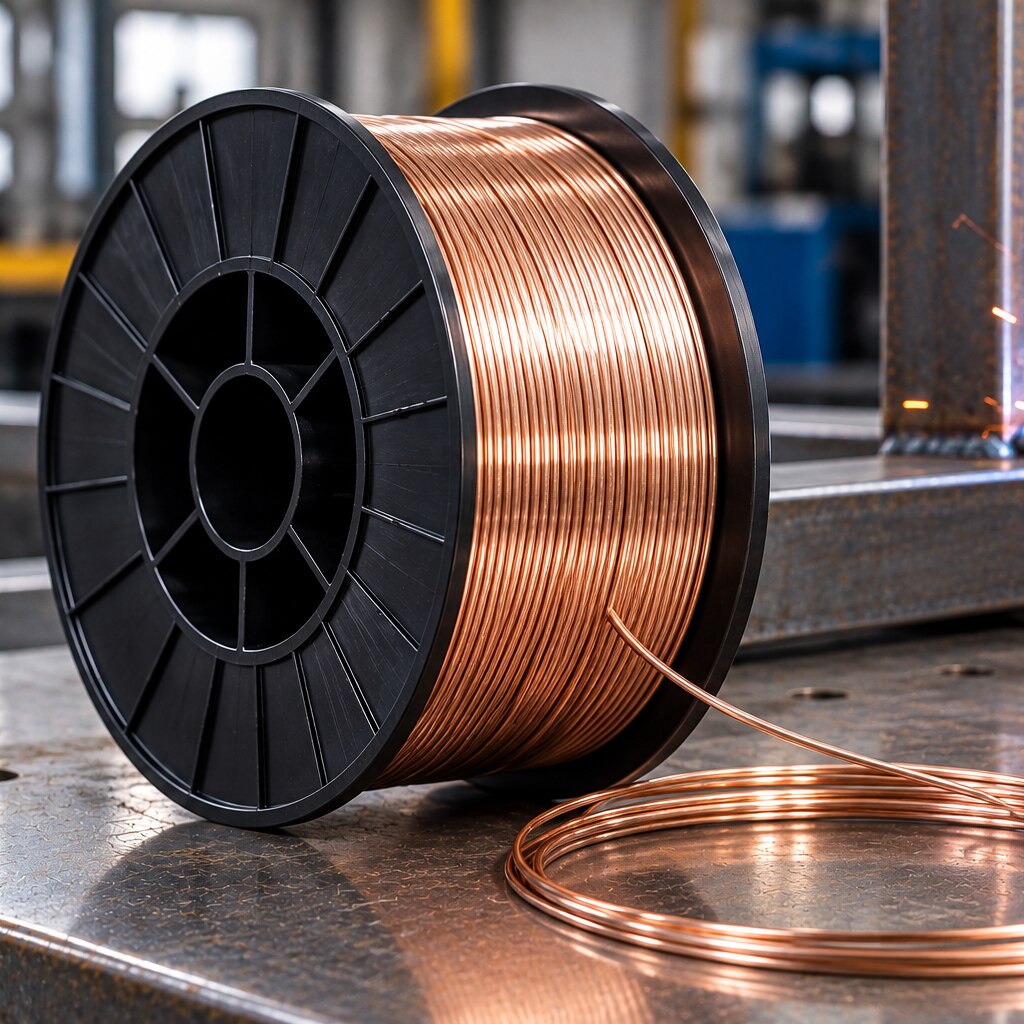
ER70S-6 is more than a wire size or a general-purpose product name: its AWS classification identifies its strength level, form and chemical-composition group. By the end, you will be able to match the wire to the base metal, select a practical diameter and shielding gas, tune the process, and protect the consumable from conditions that cause weld defects.
Key takeaways
- Match wire diameter to steel thickness, joint position and welding current range.
- Clean rust, oil, paint and moisture before relying on silicon and manganese deoxidisers.
- Use argon-CO2 blends for control or pure CO2 for stronger penetration and economy.
- Keep wire sealed, dry and traceable with its AWS classification and batch details.
What does ER70S-6 mean, and which steels does it fit?
ER70S-6 meaning comes from the AWS A5.18 and AWS A5.18M classification system. It is a 70 ksi tensile strength welding wire strength classification, but each character adds information:
| Part | Meaning |
|---|---|
| ER | Electrode or rod |
| 70 | Minimum all-weld-metal tensile-strength level of 70 ksi (480 MPa) |
| S | Solid wire |
| 6 | Specified chemical-composition group |
The classification test also requires at least 58 ksi (400 MPa) yield strength and 22% elongation in 2 in. (50 mm). These are test minimums, not guaranteed values for every production weld made with every gas and parameter set.
The specified chemistry typically limits carbon to 0.06–0.15%, manganese to 1.40–1.85%, silicon to 0.80–1.15%, phosphorus to 0.025% maximum, sulfur to 0.035% maximum and copper to 0.50% maximum. The suffix 6 does not identify welding position, low-hydrogen performance or notch toughness.
ER70S-6 usually fits mild steel and suitable low-alloy carbon steels when the required weld-metal strength is in the 70 ksi class. Confirm the following before welding:
- Base-metal grade and joint design
- Governing code and qualified WPS
- Preheat, interpass-temperature and heat-input limits
Specified Charpy toughness or low-temperature service requires a supplementary classification, supporting test data or a qualified procedure; “6” alone proves none of these.
How do manganese and silicon affect surface preparation?
ER70S-6 manganese and silicon levels exceed those in lower-numbered solid wires such as ER70S-3. These deoxidisers in welding wire react with oxygen in the weld pool, improving tolerance of light mill scale and minor surface oxidation while changing weld-pool fluidity, arc behaviour and spatter levels.
That tolerance has a firm limit. Carbon steel surface preparation must remove oil, paint, heavy rust, moisture, cutting-fluid residue and loose mill scale; higher deoxidiser content is not permission for mill scale welding through thick scale, wet steel or paint.
Prepare the joint in this order:
- Degrease the joint and nearby surfaces first. Oily residue can decompose in the arc, causing porosity and adding hydrogen to susceptible joints.
- Mechanically remove rust and loose scale with a clean wire brush, abrasive wheel or other suitable method.
- Dry the joint completely. Moisture can generate hydrogen and porosity, and solid wire has no flux coating to absorb or shield that contamination.
- Inspect the groove, root face and surrounding area before fit-up. Remove grinding dust, embedded residue and remaining loose scale.
Cleaning fixes contamination, not filler-metal incompatibility. ER70S-6 remains unsuitable when the base metal requires a different alloy, strength level, toughness classification or hydrogen-control procedure. Check the material specification and qualified welding procedure before treating a clean surface as proof that the wire is appropriate.
How should you choose the wire diameter and starting parameters?
A smaller ER70S-6 wire diameter lowers the current needed to maintain a stable arc, limits deposition rate and improves control on thin sections or out-of-position joints. A larger diameter carries more current and deposits metal faster, but it demands a joint and position that can control the larger, hotter weld pool.
| Diameter | Current and deposition | Heat input and positional control | Typical use |
|---|---|---|---|
| 0.8 mm welding wire | Lowest range; lowest deposition | Lowest heat and strongest short-arc control | Thin sheet and out-of-position work |
| 0.9 mm welding wire | Low-to-moderate range; moderate deposition | Good short-circuit control | Thin-to-medium sections and general fabrication |
| 1.0 mm welding wire | Moderate range; higher deposition | More heat; less forgiving in difficult positions | Medium sections and controlled fillet welds |
| 1.2 mm | Higher range; highest deposition | Higher heat; suited to flat or horizontal work | Thicker sections when joint access permits |
Use DCEP, with the electrode positive, and start with the machine and wire manufacturer’s coordinated wire-feed-speed, voltage, contact-tip-to-work distance, gas-flow and travel-speed range. Adjust for joint geometry, transfer mode and actual machine behaviour; diameter is not a substitute for a qualified WPS.
Short-circuit transfer suits thinner sections and out-of-position joints. Spray transfer requires higher current, an argon-rich gas and a suitable diameter, so do not transfer short-circuit settings to spray work.
Excessive stick-out changes arc length, deposition and shielding. A worn or oversized contact tip causes arc wandering and unstable current transfer. Confirm bead profile, fusion, spatter and heat input against the qualified WPS.
Which shielding gas gives the right balance of penetration and control?
Choose gas by transfer mode and joint demands, not by wire classification alone. ER70S-6 shielding gas options include 100% CO2 welding gas and argon-rich blends such as 75% argon 25% CO2.
| Gas | Arc and penetration | Best fit | Main trade-off |
|---|---|---|---|
| 100% CO2 | Hotter arc, deeper penetration | Thick sections, high productivity, short-circuit or globular transfer | Lower gas cost, but more spatter and oxidation |
| 75% argon 25% CO2 | Smoother arc, controlled penetration, lower spatter | Better bead appearance, positional work and spray transfer | Higher gas cost and procedure requirements |
| Argon-rich blend for spray | Stable spray transfer at higher current | Thick plate, fast deposition and a suitable wire diameter | Requires qualified parameters, adequate plate thickness and correct position |
Use CO2 when penetration and gas cost outweigh cleanup. Use the argon-rich mixture when appearance, control, lower spatter or spray transfer shielding gas matters. Short-circuit transfer suits thinner plate and out-of-position joints; spray transfer needs higher current and an argon-rich blend.
ER70S-6 is bare solid wire for gas-shielded GMAW, not self-shielded flux-cored wire. Check these causes before blaming the wire:
- Verify cylinder pressure and gas flow; inspect the diffuser and nozzle for blockage.
- Leak-check hose connections and keep the nozzle clean.
- Correct excessive stick-out, drafts and inadequate coverage.
- Outdoors, install wind protection. Do not simply increase flow: turbulence can draw air into the shielding envelope and cause porosity.
How should you store, inspect and source ER70S-6 wire?
Before the spool reaches the machine, use this consumable-control checklist:
- Keep the original spool sealing intact until use. Store it in a clean, dry area away from condensation, moisture, dust, grinding debris and shop chemicals.
- Inspect the packaging, label, wire surface and spool flange. Stop and investigate rust, dirt, damaged packaging, an unreadable welding consumable batch number or irregular wire feeding.
- Cover or reseal a partly used spool as soon as you remove it from the feeder. Do not assign a shelf life without checking the brand and pack type.
| Defect | What can go wrong | What to check |
|---|---|---|
| Contamination | Porosity and hydrogen-related cracking risks in susceptible joints | Moisture, oil, dust and chemical residue |
| Rust or dirt | Liner fouling, contact-tip damage, unstable feeding and altered current transfer | Wire surface and feeder path |
| Damaged flange or packaging | Erratic unwinding and exposure to shop contaminants | Flange, seal and outer wrap |
Ask the supplier for the product classification, diameter, batch or heat identification and welding wire certificate values. Compare the certificate chemistry with the AWS A5.18/A5.18M limits and your project specification; actual values can be narrower than classification limits, so the certificate provides more control than relying on the ER70S-6 suffix alone.
For Mumbai fabricators and industrial repair teams, RND Welding Pvt Ltd can help match diameter, classification documents, packaging condition and supply requirements instead of leaving you with an unverified spool. Proper ER70S-6 spool handling protects both weld quality and feeder performance.
Frequently asked questions
What does ER70S-6 mean, and which steels does it fit?
ER70S-6 is an AWS A5.18/A5.18M carbon-steel solid wire classification with a 70 ksi minimum tensile-strength class. It suits clean to lightly contaminated carbon and mild steels when the welding procedure matches the base metal and joint.
How do manganese and silicon affect surface preparation?
Manganese and silicon act as deoxidisers, helping the weld pool tolerate limited surface scale. They do not replace cleaning: remove oil, paint, rust, moisture and heavy mill scale before welding.
How should you choose ER70S-6 wire diameter and starting parameters?
Select diameter from steel thickness, joint access, welding position, transfer mode and the machine's rated current range. Set voltage, wire-feed speed, polarity and shielding flow from the wire manufacturer's procedure, then tune with a test weld.
Which shielding gas gives the right balance of penetration and control?
Argon-CO2 blends usually provide a smoother arc and better control, while 100% CO2 provides deeper penetration and lower gas cost with more spatter. Choose the gas that suits transfer mode, position, thickness and finish requirements.
How should you store, inspect and source ER70S-6 wire?
Store sealed spools in a clean, dry area and prevent condensation, oil and damage. Before use, inspect the package, wire surface, AWS classification, diameter, batch number and manufacturer's documentation.