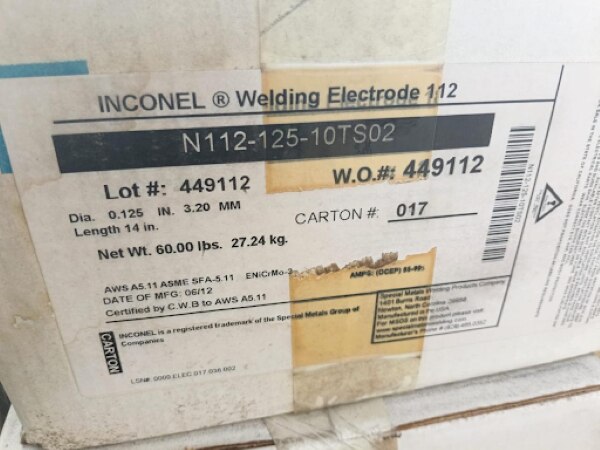
“Inconel 112” is a purchasing label, not a diameter, and it must be matched to the AWS classification ENiCrMo-3 before you approve a nickel-alloy electrode. You will be able to compare grades, request traceable documents, specify welding controls and judge whether a Mumbai supplier can support the job rather than merely quote a price.
Key takeaways
- Match Inconel 112 with AWS A5.11/A5.11M ENiCrMo-3.
- Ask for the batch number, mill certificate and certificate of conformance.
- Keep electrodes dry and follow the manufacturer’s rebaking and holding limits.
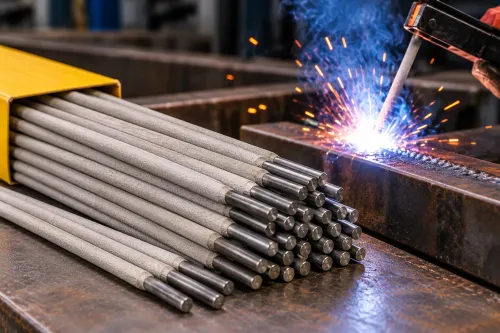
- Use SMAW when site access and joint complexity outweigh production speed.
Match “Inconel 112” to the correct nickel-alloy grade
ENiCrMo-3 is the AWS A5.11/A5.11M classification normally meant by “Inconel 112.” It welds INCONEL alloy 625 and comparable nickel-chromium-molybdenum alloys, and suits nickel-alloy joints, corrosion-resistant overlays, and dissimilar connections to carbon steel, low-alloy steel or stainless steel. The deposit’s chromium, molybdenum and niobium content supports resistance to corrosion and localized attack.
| Electrode classification | Deposit and typical use | Selection boundary |
|---|---|---|
| ENiCrMo-3 | Nickel-chromium-molybdenum-niobium; alloy 625-type joints, dissimilar welds and overlays | Check the qualified WPS for dilution and service chemistry |
| ENiCrFe-3 | Nickel-chromium-iron deposit; many nickel-alloy-to-steel and stainless transitions | Not an automatic substitute for ENiCrMo-3 in severe corrosion |
| ENiCrCoMo-1 | Nickel-chromium-cobalt-molybdenum deposit | Use when the base metal and service specification call for its chemistry |
| ENiCu-7 | Nickel-copper deposit; commonly associated with copper-nickel alloys | Do not select it for a 625-type joint merely because it is a nickel electrode |
Treat “Inconel welding electrode 112 in Mumbai” as a search description, not a complete specification. “Special Metal NiCrMo 3 electrode” also needs verification against the manufacturer’s exact designation.
Ask for these details before accepting an offer:
- AWS A5.11/A5.11M ENiCrMo-3 classification
- Diameter and electrode length stated separately from “112”
- Permitted polarity, normally DCEP, and the product’s current range
- Approved base-metal combination, construction code and qualified WPS
- Batch certificate, deposited-chemistry data, and lot or heat traceability
A packet or certificate that says only “NiCrMo-3” does not prove classification compliance.
Specify the electrode and documents before you buy
A purchase order for inconel smaw electrodes in mumbai must identify the consumable beyond the word “Inconel.” “Inconel 112” is a trade designation or nickname, not a diameter, so state the AWS classification and size separately.
- Specify AWS A5.11/A5.11M ENiCrMo-3, including the manufacturer’s exact product name and classification evidence.
- State the nominal diameter and electrode length, such as 2.5, 3.2 or 4.0 mm, only after confirming the qualified welding procedure.
- Name the approved base-metal combination: alloy 625, another nickel-chromium-molybdenum alloy, stainless steel, carbon steel, clad plate or a dissimilar transition.
- Identify the applicable construction code and qualified WPS, such as ASME Section IX, AWS D1.1 or the project specification.
- State DCEP polarity unless the product data sheet permits AC, and require the manufacturer’s current range for the specified diameter.
- Require sealed original packaging, batch or heat identification, manufacture date, shelf-life information and storage instructions.
- Request a certificate of conformity or EN 10204 inspection certificate when the project requires it, plus deposited-weld chemistry and mechanical-test data.
- Require the technical data sheet, certificate traceability to each box, packaging-condition record and delivery documentation.
Do not accept “nickel electrode” as a substitute for ENiCrMo-3. ENiCrFe-3, ENiCrCoMo-1 and ENiCu-7 have different deposited chemistry and service applications; the WPS must confirm compatibility and dilution control. Include opening date and electrode-issuance records for moisture control, and follow the maker’s rebake and holding limits rather than adding a generic rebake instruction.
Set the SMAW procedure for nickel-alloy joints
Set an ENiCrMo-3 procedure around a clean joint, DCEP, a short arc and controlled heat input. The approved WPS must state the joint design, preheat, maximum interpass temperature, bead sequence and any post-weld heat treatment.
1. Confirm the base-metal grades and joint configuration, then set the bevel, root opening, alignment and tack-weld method in the WPS. Include separate requirements for nickel alloy-to-nickel alloy, stainless steel and carbon or low-alloy steel joints.
2. Remove oil, grease, paint, sulfur-bearing residue, lead, zinc and copper from the joint faces and nearby surfaces. Mechanically clean and degrease them, then use dedicated stainless or nickel-alloy brushes and grinding tools; carbon-steel residue can cause porosity or cracking.
3. Use DCEP unless the ENiCrMo-3 manufacturer’s data sheet permits AC. Set amperage from the electrode diameter and that product’s stated range, not from an ENiCrFe-3 or other nickel-alloy electrode.
4. Apply only the preheat specified by the WPS, and monitor the maximum interpass temperature with temperature-indicating crayons or a contact thermometer. Do not copy a carbon-steel preheat practice; excessive temperature raises heat input and distortion.
5. Hold a short arc and use narrow, controlled beads rather than wide weaving. Keep travel consistent, pause at the bead edges for fusion, and avoid an arc length or current that creates excessive spatter, oxidation or penetration.
6. Remove all slag after every pass and inspect both bead toes before continuing. Correct trapped slag or incomplete overlap immediately, then complete any specified post-weld heat treatment and inspection.
Control moisture and assess the Mumbai supplier
A quotation does not prove that an inconel electrode supplier in mumbai can deliver usable welding consumables. Release the order only after the supplier identifies the manufacturer, AWS A5.11/A5.11M classification, diameter, batch and remaining shelf life.
Ask for these records before dispatch:
- Manufacturer’s technical data sheet stating operating current, polarity, storage limits and rebake instructions
- Certificate of conformity or EN 10204-style inspection certificate, when your specification requires one
- Batch certificate showing deposited-weld-metal chemistry, not just the product name
- Photographs or written confirmation that the original cartons and moisture-resistant seals are intact
- Batch number, manufacturing date, shelf-life statement and delivery record
Do not accept “Inconel 112” alone as identification. Confirm that the package says ENiCrMo-3, then compare its deposited chemistry with the qualified WPS for alloy 625, alloy 825, stainless steel, carbon steel or a clad transition. A catalogue label cannot establish compatibility or control dilution.
Mumbai humidity makes electrode custody part of quality control. Record the carton opening date, issue rods in controlled quantities, and return unused electrodes according to the manufacturer’s instructions. If exposure requires rebaking, follow the stated temperature and time; repeated or excessive rebaking can damage some coatings.
RND Welding Pvt Ltd can be assessed on the same evidence: traceable batch documents and storage controls matter more than a broad product list.
Related products
 | Welding Electrodes E nicrcomo-1welding electrodes ₹ 4,000/KgGet Latest Price Diameter 2.5 mm X 450 mm Material Stainless Steel Brand Arcos Application/Usage Construction Operating Current AC/DC Size... View product → |
 | Welding Electrodes Enicrfe3 Stainless Steel Welding Rod Diameter - 2.5/3.15/4.00/5.00mm Material - NICKEL Welding rod Brand - Esab / Ador / D&H SECHERON/ HONAVOR Application/Usage Construction Country of... View product → |
Decide when SMAW is the right production process
SMAW makes sense for nickel-alloy work when the joint is in the field, access is restricted, or repair work does not justify moving mechanised equipment. An ENiCrMo-3 electrode suits INCONEL 625-type alloys, nickel-chromium-molybdenum alloys, dissimilar joints and corrosion-resistant overlays only when the qualified WPS confirms base-metal compatibility and dilution limits.
| Process | Best fit | Main trade-off |
|---|---|---|
| SMAW | Repairs, field fabrication, confined access | Lower deposition rate; slag, moisture and stub losses depend heavily on the operator |
| GTAW | Root passes, thin sections and high-cleanliness welds | Slower filler deposition and greater operator time |
| GMAW | Repetitive fabrication with controlled access | Requires shielding-gas control, wire-feed equipment and suitable transfer settings |
| SAW | Long, accessible production seams | Poor fit for short, positional or restricted-access joints |
Compare processes before committing to a long seam. The higher purchase price of nickel-alloy electrodes combines with lower deposition efficiency, discarded stubs, slag removal and rework, so SMAW can cost more in production time even when equipment costs less.
Ask a smaw electrodes supplier in mumbai for the ENiCrMo-3 data sheet and deposited-chemistry certificate, then confirm polarity and current range. ENiCrMo-3 commonly runs DCEP; use AC only when the product data sheet permits it. State AWS A5.11/A5.11M classification and diameter separately—“112” identifies the classification, not the electrode size.
Frequently asked questions
What classification matches Inconel 112?
Inconel 112 normally refers to AWS A5.11/A5.11M ENiCrMo-3, a nickel-chromium-molybdenum electrode used with INCONEL alloy 625 and comparable alloys.
Which documents should you request before buying an Inconel electrode?
Request the manufacturer’s product data sheet, certificate of conformance, batch or heat number, AWS classification and storage or rebaking instructions. Match those details with your purchase specification.
How should you control moisture in Inconel SMAW electrodes?
Inspect the package seal, record the batch number and follow the manufacturer’s drying, rebaking and holding-temperature instructions. Reject electrodes with damaged packaging, visible contamination or uncertain storage history.
When is SMAW suitable for nickel-alloy welding?
Choose SMAW for repair work, restricted access, site welding and complex joints where portable equipment matters. Compare it with GTAW or GMAW when deposition rate, heat control and long production runs are priorities.
Keywords