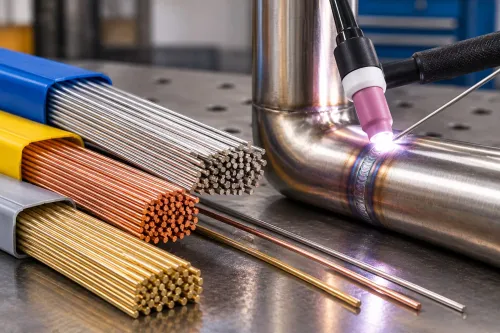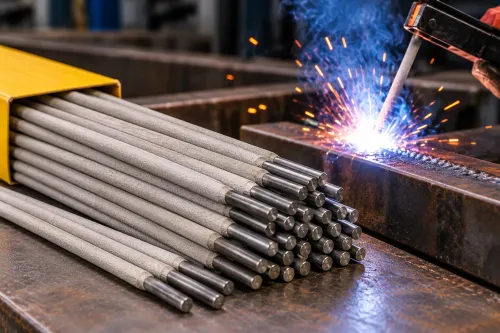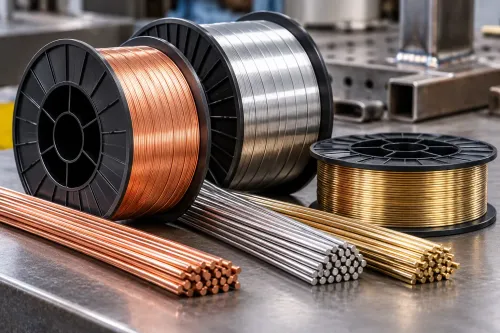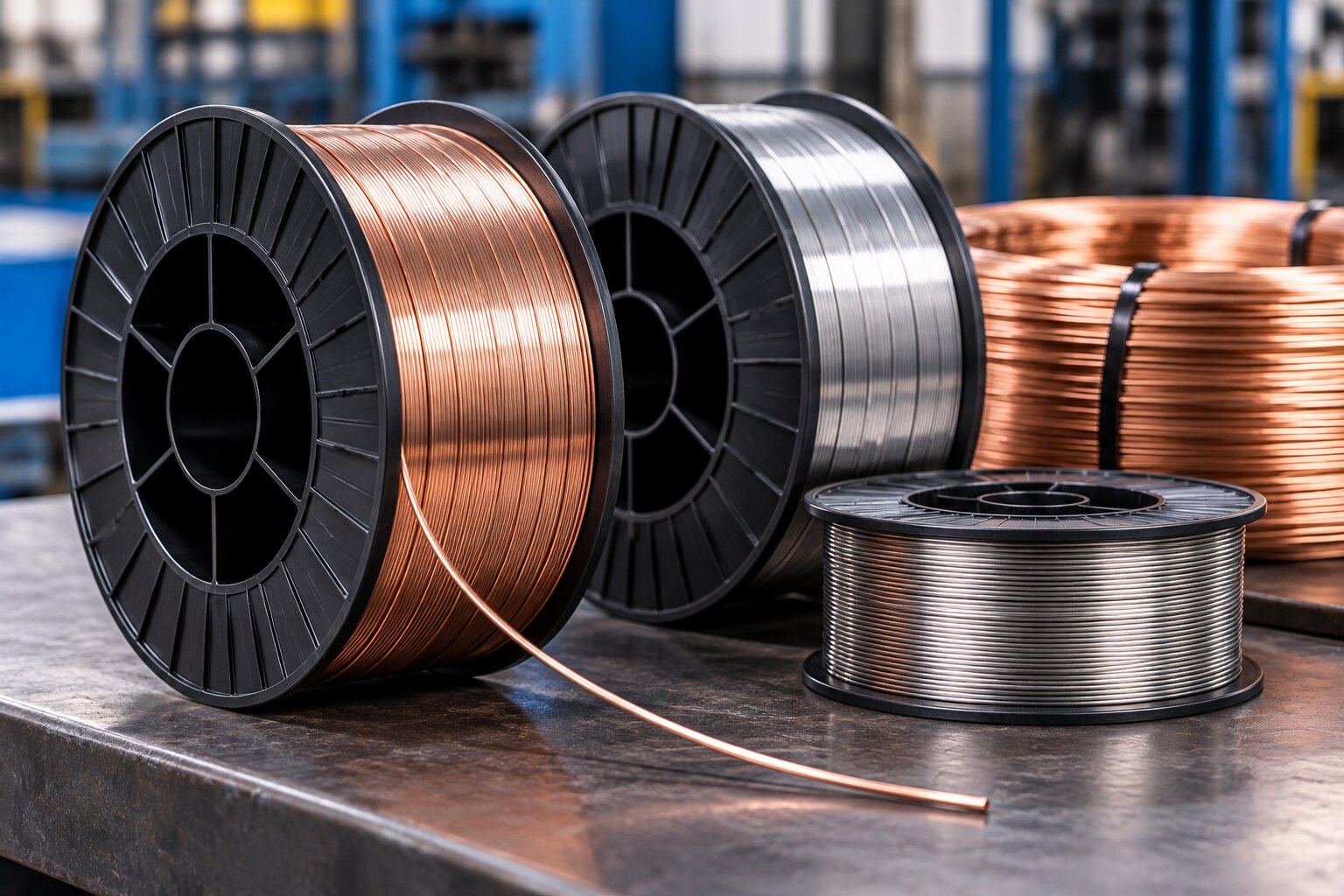
A welding wire that looks suitable by diameter or tensile-strength number can still produce porosity, spatter, poor penetration or an unqualified weld. You will be able to check the base metal, joint, process, classification, gas, polarity, diameter, documentation and storage conditions before approving a spool for production.
Key takeaways
- Select wire by base-metal grade, joint design and welding position.
- Check the wire classification before comparing trade names or prices.
- Match shielding gas, polarity and diameter to the wire and feeder.
- Inspect spool labels, certificates, seals and storage conditions before production.
Start With the Joint, Base Metal and Welding Position
Choose the wire family from the base-metal grade, joint and welding position before comparing brands or prices. Match carbon steel welding wire to the steel grade, thickness, joint restraint and required weld strength. For low-alloy steel, verify alloy matching, preheat temperature and hydrogen-control requirements; a dry-looking wire does not prove low hydrogen.
Check impact toughness at the required service temperature, not room-temperature strength alone.
| Material or joint | Wire direction | Checks before approval |
|---|---|---|
| Carbon steel | Match the grade and strength requirement | Thickness, restraint and weld size |
| Low-alloy steel | Match alloy chemistry and strength | Preheat, hydrogen designation and exposure control |
| 300-series stainless steel | ER308L for compatible combinations | Grade, chemistry and corrosion service |
| Stainless-to-carbon steel | ER309L is commonly selected | Dilution, corrosion exposure and temperature |
| 316 stainless steel | ER316L for molybdenum-bearing applications | Confirm the stainless steel filler wire guide and specification |
| Galvanised steel | Select a procedure for coated steel | Remove zinc, provide ventilation and control porosity and fume; ordinary mild-steel wire cannot solve the coating problem |
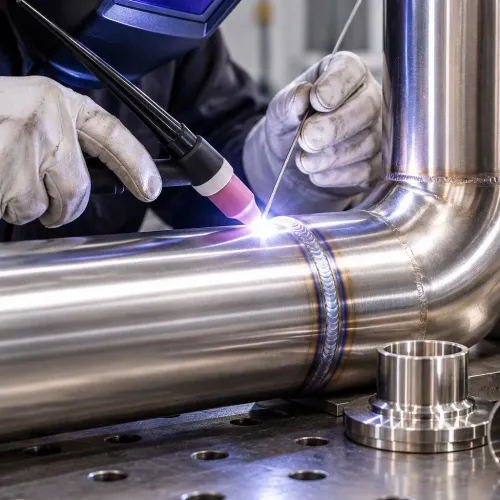
Record the joint type, root gap, access, welding position and required code before release. Include whether the weld is flat, horizontal, vertical-up or overhead: a wire that behaves well on a flat fillet may give poor puddle control overhead.
Dissimilar joints need a filler chosen for dilution, corrosion exposure and service temperature, not merely the stronger-looking designation.
Read the Classification Before the Trade Name
The classification tells you what a wire is approved to do; the trade name only identifies who sells it. Read the complete AWS or ISO designation before comparing price or brand.
| Wire type | Classification clue | Where it fits |
|---|---|---|
| Solid wire | ER70S-6, ER308L | External shielding gas and GMAW; ER70S-6 provides more manganese and silicon deoxidising capacity than ER70S-3, but it does not replace cleaning |
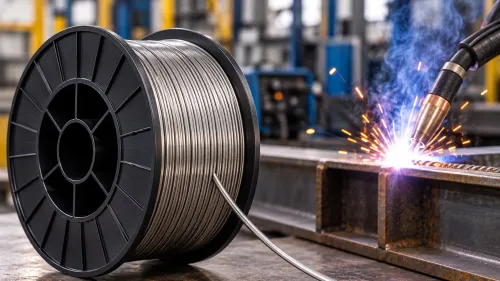
| Flux-cored wire | E71T-1 or another complete E71T designation | Powder-filled tube; gas-shielded and self-shielded FCAW wires are not interchangeable, so match the gas suffix to the data sheet and WPS |
| Metal-cored wire | Complete metal-cored classification | Metallic alloying and fluxing ingredients support high deposition and a broad arc, but require compatible equipment, gas and controlled parameters |
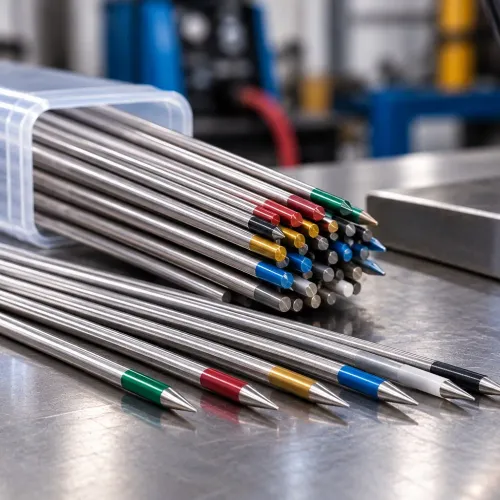
ER308L means an electrode or rod with 308 stainless weld-metal chemistry and low carbon content. That chemistry does not make it suitable for every stainless grade or joint. Likewise, ER70 is not a complete selection: the S-6 identifies solid-wire construction and the final classification carries usable performance information.
Before substitution, compare:
- Tensile and yield strength, elongation, impact toughness, stainless chemistry and ferrite control.
- Hydrogen designation such as H4, H8 or H16, plus all-position capability where specified.
- Shielding gas, polarity and process requirements.
Changing classification, gas, polarity or process can require requalification under AWS D1.1 or ASME Section IX. Treat the brand as identification, not specification.
Match Shielding Gas and Polarity to the Wire
Use exact shielding gas selection and polarity from the wire manufacturer’s data sheet and qualified WPS. For solid carbon-steel wire, an argon-rich blend can produce a smoother arc, lower spatter and controlled transfer; a carbon-dioxide-rich blend changes penetration, arc behaviour, fume and bead appearance. Pure CO2 is not an automatic substitute for an argon/CO2 mix.
| Wire type | Gas choice | Operating implication |
|---|---|---|
| Solid carbon-steel wire | Argon-rich blend or listed carbon dioxide welding gas | Blend changes transfer, penetration, spatter and bead profile |
| Gas-shielded flux-cored wire | Gas and suffix specified for the classification | E71T-1 for external shielding is not automatically suitable for self-shielded work |
| Self-shielded flux-cored wire | No external shielding gas unless the data sheet says otherwise | Adding gas can disrupt the qualified arc and weld profile |
Set flow within the torch and wire manufacturer’s range, then verify it at the nozzle during welding. Excessive flow creates turbulence and draws in room air; low flow or a shop draft causes porosity. Check DCEP versus DCEN and any specified AC condition before striking an arc.
Wrong polarity can produce instability, spatter, shallow or excessive penetration and a changed deposition rate. Record gas composition, flow, polarity and stickout together: changing one can invalidate the parameter combination.
Choose Diameter for Thickness, Position and Feeder Compatibility
Choose a diameter that delivers the required deposition rate within the qualified current range without losing control of the weld. Welding wire diameter selection must account for material thickness, joint access, welding position, expected heat input and the feeder.
| Diameter | Advantage | Control risk |
|---|---|---|
| Small | Fine current control and access to restricted joints | Slower production or insufficient deposition for large groove welds |
| Large | Higher deposition in accessible flat or horizontal work | Needs higher amperage and is harder to control on starts, short welds, root passes and positional welds |
Do not copy a diameter from another wire. Use the manufacturer’s parameter range and the qualified WPS; changing diameter alters current density, melting rate, penetration and heat input even when voltage and travel speed remain unchanged.
Before installation, confirm these feeder matches:
- Contact-tip bore and liner size
- Drive-roll groove and feeder capacity
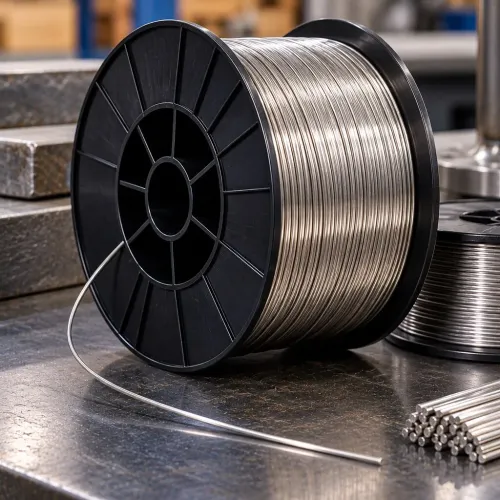
- Spool format and maximum spool weight
Inspect cast and helix during feeding. Excessive cast increases contact-tip wear and causes erratic electrical pickup. Excessive helix makes the wire wander after leaving the tip, which can shift bead placement during long-stickout or mechanised welding.
If the wire shows rust, oil, drawing residue, damaged copper coating or moisture, stop and investigate recurring feed faults. Contamination increases contact resistance, destabilises the arc and accelerates liner and tip wear.
Verify the Spool, Certificate and Storage Before Production
A spool is production-ready only when you can identify it, prove its properties and show that it remains within the qualified procedure.
1. Request the full classification, diameter, lot or heat number, manufacturer data sheet and welding wire certificate. The certificate must identify the actual spool and show applicable chemical and mechanical results; a generic product-family certificate is not lot traceability.
2. Compare tensile strength, yield strength, elongation, Charpy V-notch impact temperature, stainless ferrite information and diffusible hydrogen H4 H8 H16 designation with the WPS and governing code. Under AWS D1.1 or ASME Section IX, changing classification, diameter, shielding gas, polarity or process can require requalification.
3. Inspect the package seal, label and wire surface condition before loading it. Look for rust, oil, drawing residue, moisture, damaged copper coating or other surface damage; contamination can cause feeding faults, contact resistance, arc instability, porosity, liner wear and contact-tip damage.
4. Keep unopened spools sealed and protect opened packages from shop humidity and condensation. Record opened-spool exposure time when the consumable specification or quality procedure requires it, especially for low-hydrogen applications.
5. When comparing suppliers, ask for lot traceability and application guidance, not only a lower price. RND Welding Pvt Ltd can help match documented consumables to a Mumbai fabrication procedure and obtain batch information before release.
A dry-looking spool is not proof of compliance: confirm its exposure history and test designation before welding restrained or low-alloy joints.
Related product
 | Welding Electrodes ₹ 800/KgGet Latest Price Material Flux cored wire Thickness 1.2 mm Wire Material SS Grade FC 308l Brand Taseto Quantity Per Roll 12.5 kg Established... View product → |
Frequently asked questions
How do you choose welding wire for a specific joint?
Start with the base-metal grade, joint design, thickness, welding position, restraint and required weld strength. Low-alloy steel also requires alloy matching, preheat control and hydrogen-control checks.
Why should you read the welding wire classification before the trade name?
The classification identifies the wire's composition, strength, usability and intended application. It gives you a technical basis for comparison across brands.
How do shielding gas and polarity affect welding wire selection?
Use the gas and polarity specified for the wire classification and welding process. The wrong combination can cause unstable arc behaviour, spatter, poor penetration and weld defects.
How do you select the correct welding wire diameter?
Choose diameter based on material thickness, welding position, required deposition rate and the feeder's liner, contact tip and drive-roll compatibility.
What should you verify on a welding wire spool before production?
Check the classification, diameter, batch or heat number, manufacturer certificate, spool condition, seal and storage history. Do not use wire with rust, contamination or damaged packaging.