
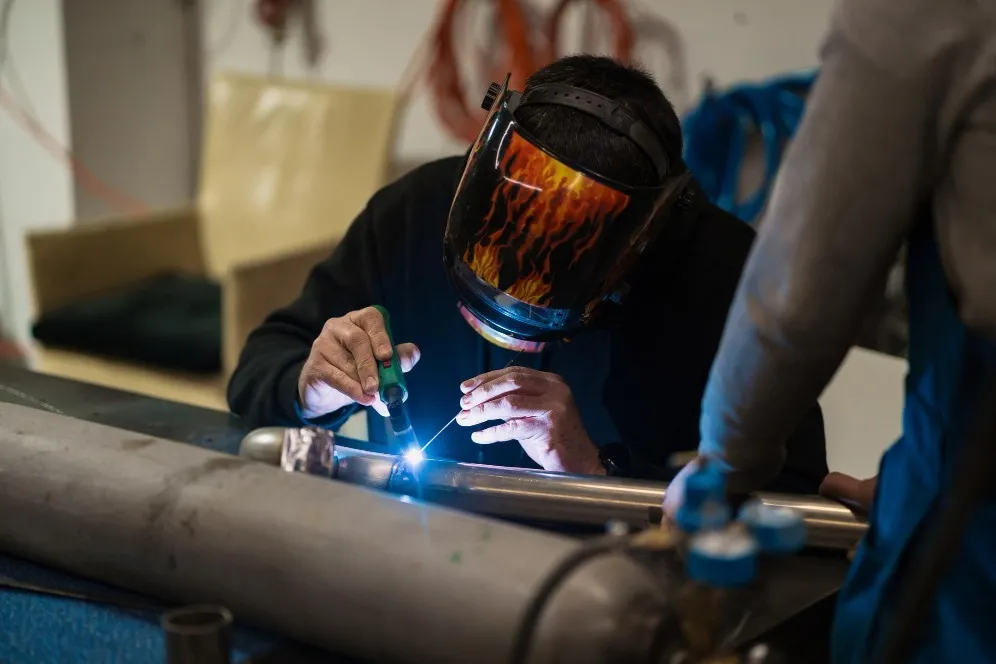
Pipe welding plays a vital role in industries where safety, durability, and leak-free performance are non-negotiable. From oil and gas facilities to power plants, chemical processing units, and heavy engineering projects, the quality of every weld directly influences operational reliability. Poor welding practices can lead to costly downtime, repairs, and even safety hazards, making it essential to follow proven methods throughout the welding process.
Industrial manufacturers and fabrication companies across Mumbai and Maharashtra often work on projects that require high-quality pipe welding for pressure systems, process pipelines, and structural applications. Understanding the fundamentals helps ensure long-term performance while reducing maintenance costs.
Why Pipe Welding Requires Precision
Unlike flat welding applications, pipe welding involves working in multiple positions, maintaining consistent penetration, and ensuring proper alignment around the pipe circumference. Small deviations can create weak points that compromise the entire system.
A successful weld depends on several factors, including:
- Proper joint preparation
- Correct welding parameters
- Suitable filler material
- Skilled welding techniques
- Thorough inspection after welding
Each stage contributes to producing a weld capable of handling pressure, vibration, temperature changes, and continuous industrial use.
Prepare the Joint Correctly
Joint preparation is one of the most overlooked aspects of pipe welding. Before welding begins, the pipe ends should be cleaned thoroughly to remove:
- Rust
- Paint
- Oil
- Moisture
- Mill scale
- Dirt and contaminants
Proper beveling creates enough space for complete weld penetration while maintaining alignment between both pipe sections.
Even high-quality welding consumables cannot compensate for poorly prepared surfaces.
Select the Appropriate Welding Process
Different projects require different welding methods depending on material type, wall thickness, and operating conditions.
Common industrial processes include:
- Shielded Metal Arc Welding (SMAW)
- Gas Tungsten Arc Welding (GTAW/TIG)
- Gas Metal Arc Welding (MIG)
- Flux-Cored Arc Welding (FCAW)
- Submerged Arc Welding (SAW)
Large industrial facilities frequently use automated or semi-automated methods for consistent results during high-volume fabrication.
Match Welding Consumables with Base Material
Using incompatible electrodes or welding wires may result in cracking, corrosion, or reduced mechanical strength.
Selection should consider:
- Pipe material
- Operating temperature
- Corrosion resistance
- Pressure rating
- Service environment
Manufacturers such as RND Welding Pvt Ltd offer a broad range of welding consumables suitable for carbon steel, stainless steel, nickel alloys, and specialized industrial applications. Choosing the right product ensures stronger weld integrity and longer service life.
Control Heat Input
Excessive heat may distort the pipe or alter its mechanical properties, while insufficient heat can lead to incomplete fusion.
To maintain consistent weld quality:
- Use recommended amperage settings.
- Maintain steady travel speed.
- Keep the arc length consistent.
- Follow approved welding procedures.
- Monitor interpass temperatures where required.
Balanced heat input improves weld appearance while reducing internal defects.
Maintain Proper Alignment
Pipe misalignment increases stress concentrations that may eventually cause failure.
Before welding:
- Verify pipe fit-up.
- Use alignment clamps where necessary.
- Measure root gap accurately.
- Confirm dimensional tolerances.
Careful positioning minimizes corrective work later in the fabrication process.
Perform Multi-Pass Welding Correctly
Many industrial pipe systems require multiple weld passes to achieve the required thickness and strength.
Between passes:
- Remove slag completely.
- Inspect each layer.
- Repair visible defects immediately.
- Maintain uniform bead placement.
Each weld layer contributes to the overall integrity of the finished joint.
Inspect Every Weld
Quality inspection helps identify hidden defects before pipes enter service.
Common inspection methods include:
- Visual inspection
- Dye penetrant testing
- Magnetic particle testing
- Ultrasonic testing
- Radiographic examination
- Hydrostatic pressure testing
Inspection requirements vary depending on industry standards and project specifications.
Common Pipe Welding Mistakes
Several avoidable errors can affect weld performance:
- Poor joint cleaning
- Incorrect filler selection
- Inconsistent travel speed
- Excessive heat input
- Inadequate penetration
- Skipping inspections
- Improper fit-up
Following established welding procedures significantly reduces these risks.
Supporting Reliable Industrial Fabrication
Pipe welding is a critical process for industries that depend on safe and efficient fluid transport systems. Consistent workmanship, appropriate consumables, and proper inspection together create durable welds capable of performing under demanding operating conditions.
Industrial buyers in Mumbai and throughout Maharashtra often prioritize suppliers that understand these technical requirements. Companies like RND Welding Pvt Ltd support fabrication businesses by supplying dependable welding electrodes, MIG wires, TIG consumables, nickel alloy products, stainless steel welding materials, and other industrial welding solutions that contribute to reliable pipe fabrication across diverse sectors.
Keywords


