
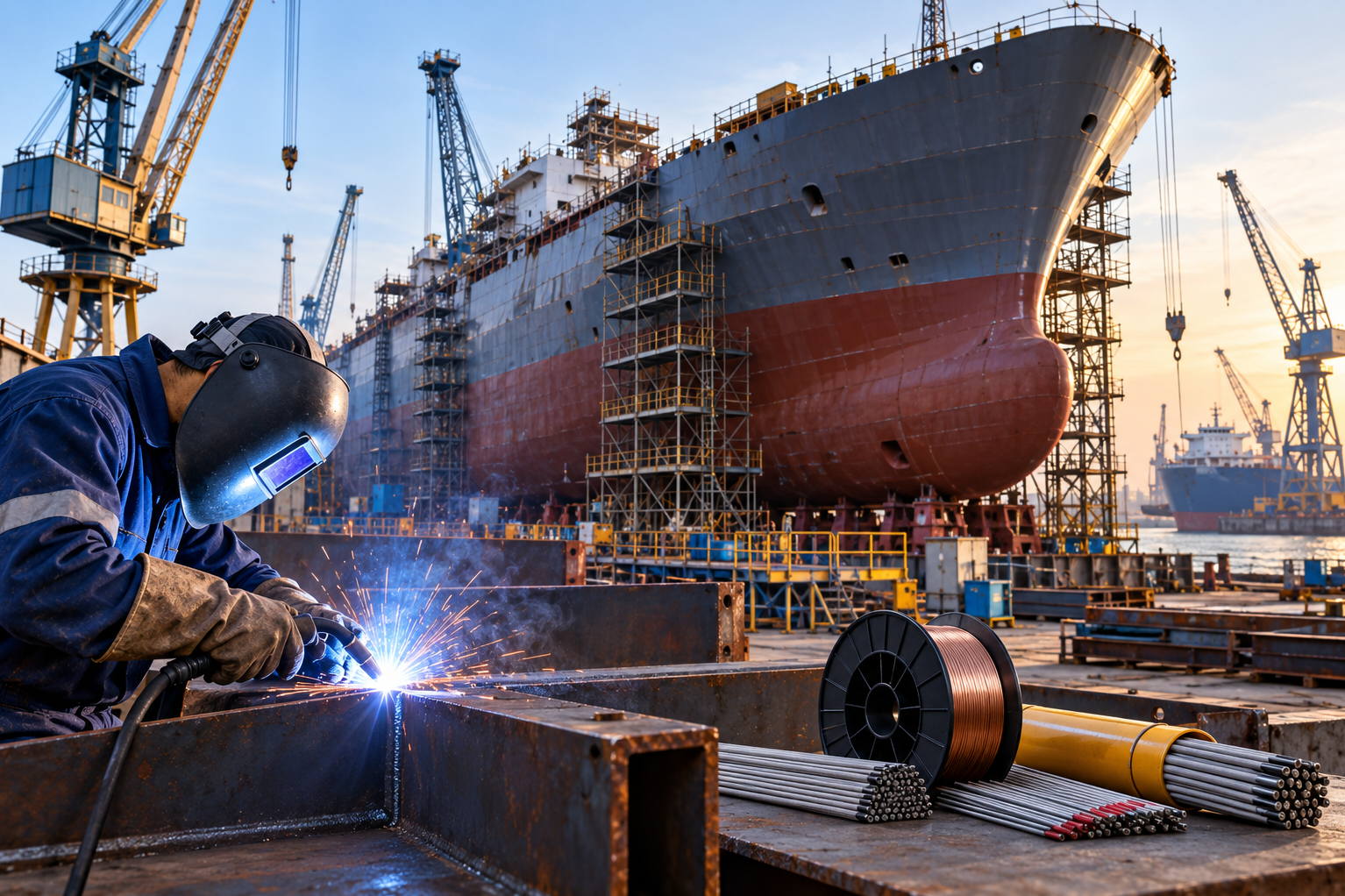
The shipbuilding industry depends on precision engineering, structural integrity, and reliable welding practices to produce vessels capable of operating safely in demanding marine environments. Every welded joint contributes to the strength of the completed structure, making the selection of welding consumables an essential part of the manufacturing process.
Whether constructing commercial ships, offshore support vessels, naval equipment, or cargo carriers, choosing appropriate welding products helps improve quality while supporting long-term operational performance.
Why Welding Plays a Critical Role in Shipbuilding
Modern ships consist of thousands of welded joints connecting structural steel, decks, bulkheads, piping systems, tanks, and supporting frameworks.
High-quality welding contributes to:
- Structural strength
- Water-tight integrity
- Corrosion resistance
- Fatigue resistance
- Operational safety
- Long service life
Consistent welding quality is especially important because marine structures experience continuous vibration, wave loading, and exposure to saltwater.
Common Welding Applications
Shipbuilding involves numerous fabrication activities.
Typical applications include:
- Hull construction
- Deck fabrication
- Bulkhead assembly
- Ballast tanks
- Fuel storage tanks
- Pipe systems
- Offshore support structures
- Engine room fabrication
- Marine repair projects
Each application may require different welding consumables depending on material type and service conditions.
Selecting Suitable Welding Consumables
The selection process should consider several technical requirements.
Important factors include:
- Base metal compatibility
- Mechanical property requirements
- Corrosion resistance
- Welding position
- Productivity expectations
- Applicable marine standards
Using compatible consumables improves weld quality while reducing the risk of costly repairs.
Common Welding Processes
Shipyards frequently use multiple welding methods during fabrication.
These include:
- Shielded Metal Arc Welding
- Flux-Cored Arc Welding
- Gas Metal Arc Welding
- Gas Tungsten Arc Welding
- Submerged Arc Welding
The selected process depends on project specifications, plate thickness, accessibility, and production requirements.
Best Practices for Marine Fabrication
Reliable shipbuilding projects follow proven fabrication procedures.
Recommended practices include:
- Prepare joints accurately.
- Remove contaminants before welding.
- Maintain approved welding parameters.
- Select certified welding consumables.
- Perform regular quality inspections.
- Follow qualified welding procedures.
- Complete non-destructive testing where required.
These practices contribute to consistent weld quality throughout the project.
Challenges During Shipbuilding
Marine fabrication presents several technical challenges.
Common issues include:
- Corrosion exposure
- Thick steel sections
- Large welded assemblies
- Tight production schedules
- Strict inspection requirements
- Variable environmental conditions
Addressing these challenges requires experienced fabrication teams and dependable welding materials.
Supporting Marine Manufacturing
Shipbuilding remains one of the most demanding industrial sectors, requiring reliable welding consumables capable of delivering consistent performance under challenging operating conditions. High-quality welding materials help manufacturers achieve structural integrity while supporting compliance with marine engineering standards.
Industrial suppliers such as RND Welding Pvt Ltd provide welding electrodes, MIG welding wires, TIG consumables, submerged arc products, nickel alloy solutions, stainless steel welding materials, and other industrial welding consumables that support shipbuilding companies, heavy engineering firms, and marine fabrication projects across Mumbai, Maharashtra, and international markets.
Keywords


